What really happens to used tennis balls?
One last pass. One last shot. One last bounce.
For millions of tennis and padel balls each year, this marks the end of their playing career.
But what actually happens to a tennis ball once it’s no longer used on the court?
Behind this familiar object—one that every player has held in their hand—lies a question that is rarely asked: What happens to a ball after its final game?
Because a ball that leaves the field doesn't just disappear. It enters a new phase in its life cycle—whether it's reused, recycled, or, unfortunately, discarded.
1. Just because a ball lands on the field doesn't necessarily mean it's the end of its life
When a ball loses its bounce, feel, or speed, most players consider it to have reached the end of its useful life.
However, a ball that is no longer suitable for competition or intensive training is not necessarily unusable.
In many situations, the main factor limiting a bullet's performance is the gradual loss of its internal pressure.
The ball appears to be "dead," but its materials are still in good condition and can sometimes be reused.
This is an important distinction: a ball may have lost its athletic qualities without having actually reached the end of its useful life.
2. The first instinct: the ball often ends up forgotten or thrown away
Whether at clubs or in people's homes, the scenario is often the same.
The balls are piling up:
- at the bottom of bags,
- in the practice baskets,
- in the clubs' reserve teams,
- or end up straight in the trash.
A ball that has been used for only a few hours may thus be removed from circulation even though it could still be useful.
The problem stems in particular from the fact that our use of balls still largely follows a simple model:
For a long time, there were few alternatives for easily extending their useful life.
3. Why is it so hard to recycle a tennis ball?
Recycling a tennis or padel ball isn't as simple as recycling an item made of a single material.
A ball is an assembly of several parts:
- a rubber core,
- a layer of felt,
- adhesives used for assembly.
To give materials a second life, we must therefore collect the bales, transport them, sort them, and then separate their various components.
There are currently initiatives in place to collect used balls and transform certain materials into new products: flooring, everyday items, or sports equipment.
However, these solutions are still limited given the enormous volume of bales used each year.
4. Initiatives that give balls a second life
In light of this, several stakeholders are now working to change the way we manage end-of-life tires.
Some initiatives are developing collection systems to prevent bales from ending up directly in regular waste.
Others are working on transforming the materials found in bales to create new objects.
These steps are essential because they allow us to repurpose a ball that is no longer suitable for sports use.
But this also raises a question:
What if the best solution were to prevent it from becoming waste too quickly?
5. Before recycling, extend the life of the bales
Recycling is an important step, but it only happens when the ball can no longer be used.
Before reaching this stage, there is another option: extending the balls' playing life.
That is precisely the purpose of repressurization.
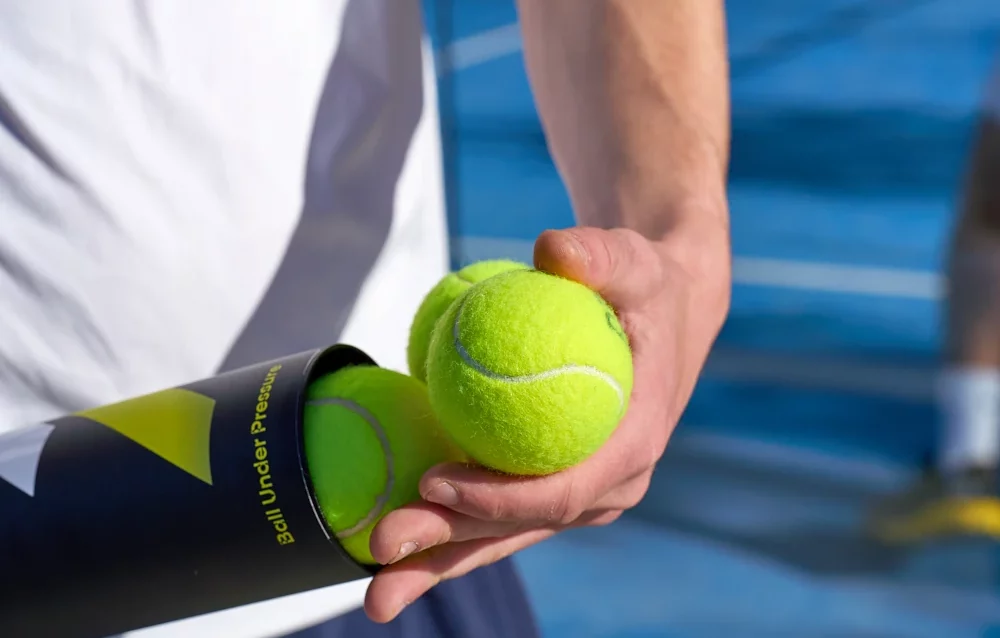
Solutions such as BUP products help restore pressure to balls that have lost some of their performance.
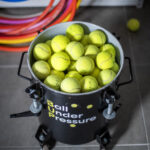
For sports clubs and organizations, the BUP120 allows for the simultaneous repressurization of up to 120 balls. This large-capacity tank was designed to meet the daily needs of clubs, coaches, and tennis schools that use a large volume of balls.
The process is simple: the balls are placed in the tank, which is then pressurized to restore the conditions necessary for the balls to regain their playing performance.
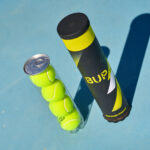
For individual players, the MiniBUP offers a compact solution designed for personal use. It allows you to repressurize several balls right at home or in your tennis bag, extending their usable life and preventing you from replacing balls that are still usable too soon.
The goal is not to replace recycling, but to delay the point at which a ball becomes waste.
After all, the most eco-friendly ball is often the one you don't have to throw away.
6. Toward a New Way of Using Balls
For decades, the model was simple:
Today, players, clubs, and other stakeholders in the tennis world are gradually beginning to rethink this approach.
From recycling and collection to reuse and repressurization, there are several solutions available to reduce the environmental impact of tennis and padel.
Changing our habits doesn't necessarily mean playing less, but simply making better use of the resources we already have.
Because before you replace a ball, maybe you should just give it a second chance.
Conclusion: Giving Tennis Balls a Second Life
Tennis and padel balls have long been considered short-lived consumables.
However, their story doesn't necessarily have to end after just a few hours of gameplay.
Understanding what happens to a ball after its final rally helps us recognize a broader issue: the need to make better use of the equipment we already have.
Thanks to recycling, responsible initiatives, and repressurization solutions such as BUP, a new approach is becoming possible.
The future of tennis and padel may lie in a sport that is not only more competitive but also more sustainable.