
Whether you’re a coach, club manager, or passionate player, you know just how crucial ball quality is to maintaining the highest level of play during practice or a match. But have you ever wondered what’s actually happening inside a ball when it loses its bounce and liveliness? Why does a brand-new padel or tennis ball become unusable after just a few hours or
days of play?
In this article, we’ll break down the scientific and technical aspects of ball pressure loss, focusing on specific data and the implications for clubs, coaches, and players.
The Science Behind Pressure: Why PSI Makes All the Difference
To understand why balls lose pressure, it is essential to review their technical specifications:
● Tennis balls are pressurized to approximately 28 PSI (pounds per square in
), which is twice the normal atmospheric pressure of 14.7 PSI.
● Padel balls, which are slightly less pressurized, are at approximately 26 PSI.
This high internal pressure is what allows a ball to bounce dynamically and meet players’ expectations. But this pressure is also its Achilles’ heel. Contrary to popular belief, balls are not airtight. The rubber core, although elastic, is a naturally porous material. It allows tiny air molecules to slowly escape through a phenomenon called gas permeability. As soon as a tube of balls is opened, the internal pressure begins to drop. And the greater the difference between the internal pressure (26 or 28 PSI) and the external pressure (14.7 PSI), the faster the air escapes.
Ball Construction: A Delicate Balance Between Performance,
, and Durability
Tennis and padel balls are designed for optimal performance, but their structure makes them less durable:
's pressurized rubber core The core is made of synthetic rubber, an elastic material that absorbs and releases energy during impacts. It is this pressurized core that determines the quality of the bounce. However, its natural porosity is the main cause of pressure loss.- The felt covering (on tennis balls)
Although the felt has no direct impact on pressure, it influences how the ball interacts with the racket and the court. Repeated friction against the ground and the strings can accelerate wear and tear, causing the ball to perform less effectively in other ways. - Strict Standards for Each Sport
Tennis balls must meet specific bounce standards (135–147 cm when dropped from a height of 254 cm). In padel, the balls bounce lower (135 to 145 cm, due to lower pressure). Inadequate pressure directly compromises these standards.
Factors that accelerate pressure loss
Even with a well-designed system, several factors can accelerate the
depressurization of the cylinders:
- Intense Use
When a ball is struck, it undergoes a sudden compression that forces air to escape more quickly. When the same batch of balls is used for intensive practice sessions or extended matches, a loss of pressure is inevitable. - Weather Conditions
○ High temperatures: Heat causes rubber to expand, allowing air to escape more easily.
○ Cold: At low temperatures, the air inside the ball contracts,
immediately reducing internal pressure and making the ball softer.
These temperature fluctuations affect the performance of the balls, especially when played outdoors. - Improper storage
○ Tires left outside their pressurized tubes or stored in hot, humid environments lose pressure more quickly.
○ Prolonged exposure to direct sunlight can also degrade the rubber, accelerating pressure loss and reducing overall durability. - Natural Degradation
Even when not in use, a ball loses about 2 PSI per month when stored outside of a pressurized tube. This phenomenon is due to the inherent properties of rubber.
Why Pressure Is Crucial for Clubs and Coaches
For tennis and padel clubs, ball quality is a key concern. Anunderinflated ball can have serious consequences:
● Training quality: Coaches need balls that provide a consistent bounce to work on accuracy and shot trajectories with their students. An underinflated ball alters the ball’s behavior during play, making drills less effective.
● The players’ experience: Soft or erratic balls detract from the enjoyment of the game, which can frustrate members and students.
● Financial costs: Clubs spend an average of €6,000 per year to replace balls that have become unusable.
How can we slow down the loss of pressure?
To maximize ball life, it is important to adopt good practices:
Pressurized Storage Storing balls in a pressurized environment at 26 or 28 PSI not on
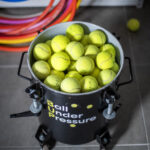
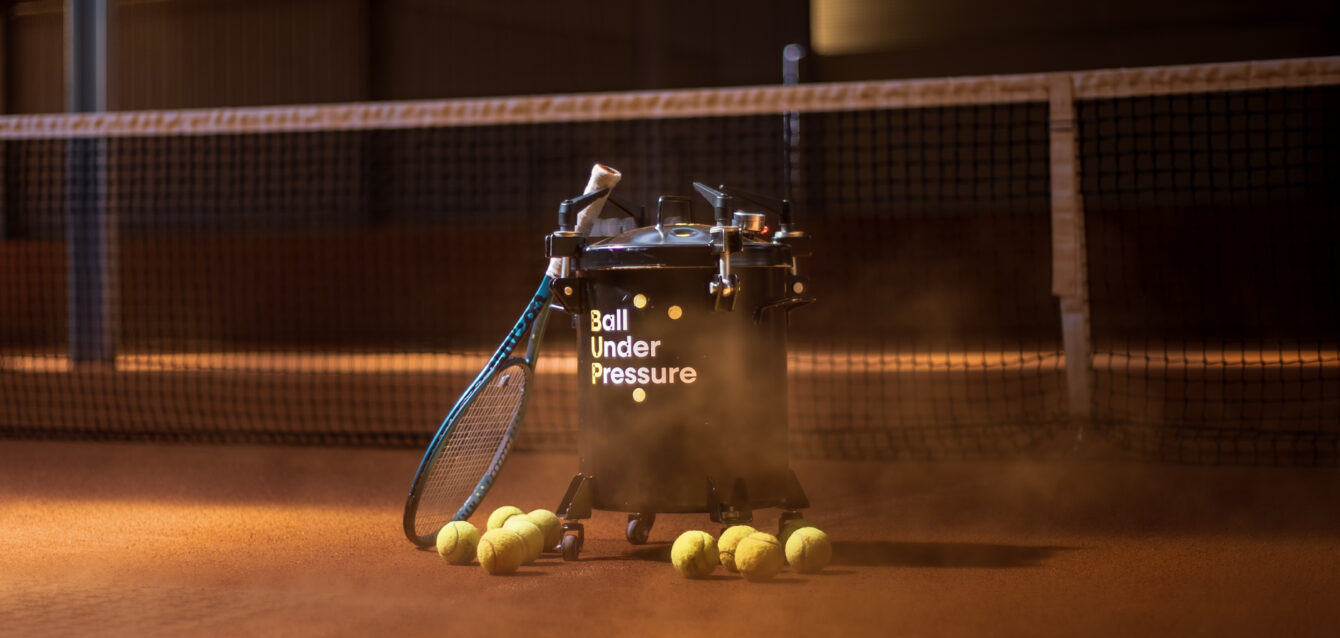
ly slows their pressure loss but also allows them to regain a few PSI. Solutions such as the BUP pressurized bucket have been specially designed to maintain the balls at optimal pressure over time.- Ideal Conditions
○ Store the balls in a dry place at room temperature.
○ Avoid prolonged exposure to sunlight or humid conditions. - Innovative Solutions
Clubs and coaches can invest in tools like the BUP, designed to restore ball pressure in less than one night. This extends the life of the balls by 3 to 4 times, while ensuring consistent performance
.
A Major Economic and Environmental Challenge
The loss of air pressure in soccer balls not only affects the game, but also has an impact on club finances and the environment:
● Economic : With balls that last three times longer, clubs can reduce their expenses by 35%.
● Environmental : Every year, 300 million tennis balls are discarded worldwide. Their production and disposal generate a significant carbon footprint. Extending their lifespan is a concrete solution to this environmental challenge.
Conclusion: solutions to revolutionize your approach
Pressure loss in tennis and padel balls is inevitable, but it can be managed. Understanding the science behind this phenomenon allows clubs and coaches to better anticipate this issue and invest in sustainable solutions.
With tools like the BUP pressurized bucket, you can not only provide your players with optimal bounce but also reduce your costs and contribute to a more environmentally friendly sport.
So why not turn this challenge into an opportunity? With a properly pressurized ball, every rally becomes an optimal experience, and every investment becomes a step toward the future of the sport and the planet.